
international phone number for business
Boost Global Growth with the international phone number for business

Think of an international phone number as your business's digital front door in another country. It’s a virtual number that lets you create a local presence anywhere in the world, without the rent or the hassle of a physical office. It’s a simple, affordable way to build trust with global customers. They can call you at local rates, and you can answer from your laptop, anywhere on the planet.
In today's market, your next big customer could be in London, Tokyo, or São Paulo. Gone are the days when "going global" was a game reserved for massive corporations with bottomless budgets. Now, any business can compete on the world stage, but winning often comes down to one simple thing: being easy to reach. This is where an international phone number changes everything.
Picture it like opening a local shop in a foreign city. When a potential customer in London sees a familiar +44 number, it feels instantly trustworthy and accessible. It’s not some strange, far-off number that screams "expensive international call." That little detail removes a huge mental barrier, making it far more likely they’ll pick up the phone and call you.
Just a few years ago, setting up an international presence was a nightmare. It meant dealing with foreign telecom giants, installing physical phone lines, and trying to make sense of confusing billing systems. That approach wasn't just expensive; it was incredibly rigid, making it nearly impossible for smaller businesses to adapt and grow.
The traditional model created friction for everyone:
Thankfully, virtual number technology provides a clean, elegant solution. By using Voice over Internet Protocol (VoIP), these numbers run entirely over the internet, completely cutting out the need for physical phone lines. This creates a powerful, flexible, and shockingly affordable communication system.
An international phone number does more than just connect calls; it builds a bridge of trust. It tells your global audience, "We're here for you, we're local, and we're easy to reach." That perception is everything when it comes to turning international interest into loyal customers.
This guide will give you a clear roadmap to building your global presence the smart way. We'll break down how an international phone number for business can unlock huge cost savings, build instant customer trust, and simplify your entire communication strategy—all from a simple, browser-based platform.
Ever wondered how a company in Chicago can have a local German phone number that rings right on their laptop? It’s not magic. It’s a brilliant piece of technology called Voice over Internet Protocol (VoIP), and it's much simpler than it sounds.
Think of it like this: a traditional phone line is like the postal service, needing a physical network of copper wires to carry your voice from point A to point B. VoIP, on the other hand, is like sending an email. It turns your voice into tiny digital packets and shoots them across the internet. This simple shift makes the whole process faster, more flexible, and way, way cheaper.
At its core, an international business phone number is just a virtual number that runs on VoIP. It isn't chained to a specific phone or a physical location. Instead, it works like a smart, digital receptionist.
When someone in Berlin dials your virtual German number, the VoIP system instantly forwards that call over the internet to any device you’ve chosen—your web browser, a mobile app, or even a different phone line. It happens in a split second.
This digital forwarding is what allows a small e-commerce shop in Ohio to give its UK customers a local London number. Customers get a familiar, low-cost way to call, and the business manages everything from one place. You’re effectively separating your business communications from a physical address, giving you true global freedom.
But not all international numbers are the same. Each type serves a different purpose, and picking the right one is crucial for your global strategy. It all comes down to who you're trying to reach and what message you want to send.
Are you ready to expand? This quick decision framework can help you see if an international number is the right next step.
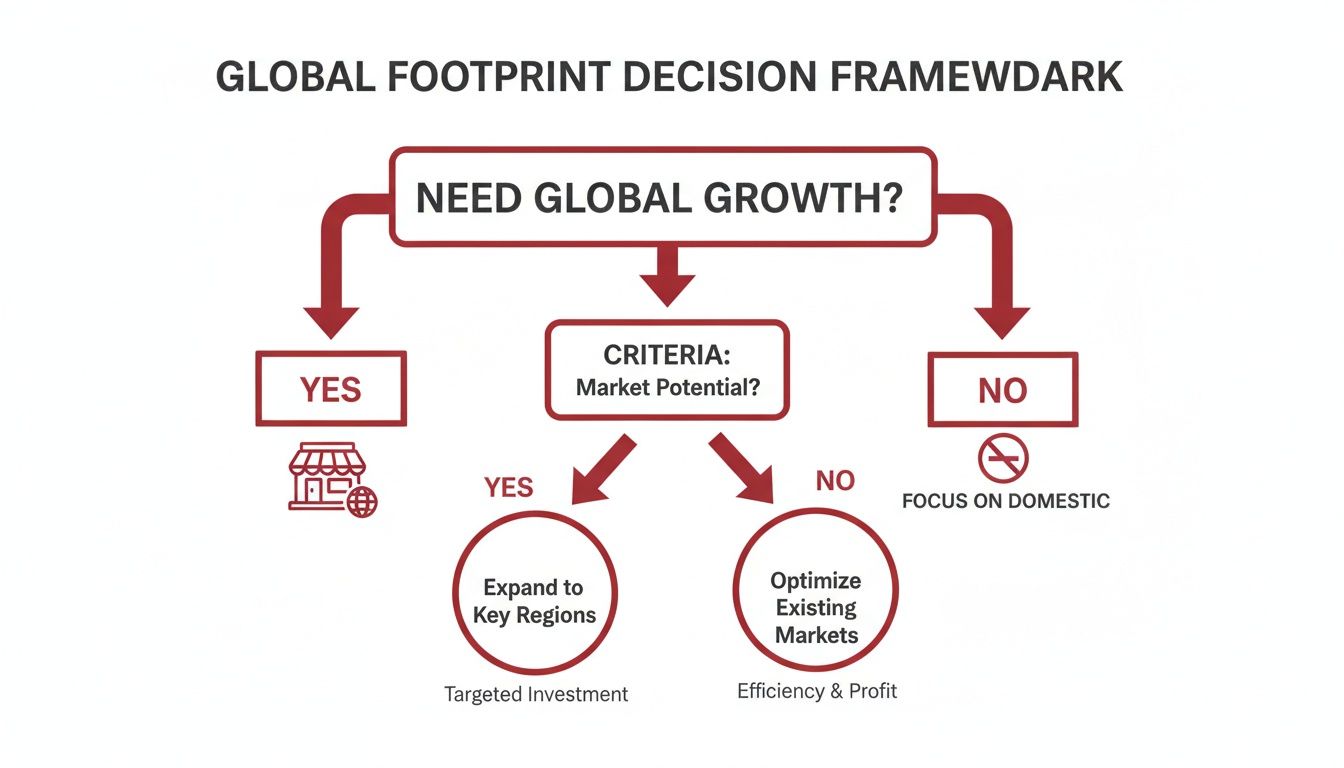
As the framework shows, a clear expansion goal points directly toward adopting a global communication tool like a virtual number.
This isn’t just a niche trend; it’s a massive shift. The global VoIP market was valued at a massive $134.86 billion in 2023 and is expected to hit $151.21 billion by 2025. This explosive growth proves businesses are ditching old-school phone carriers for internet-based solutions that can slash communication costs by up to 90%.
To help you decide, here’s a quick breakdown of the most common number types you'll encounter. Each one is designed for a specific business scenario.
| Number Type | Primary Function | Best For |
|---|---|---|
| Local Numbers | Establish a presence in a specific city (e.g., London's +44 20 code). |
Businesses targeting customers in a specific metro area, creating a "local storefront" feel. |
| National Numbers | Cover an entire country without being tied to a specific city. | Companies serving a whole country, projecting a larger, nationwide presence. |
| Toll-Free Numbers | Allow customers to call for free, removing any barrier to contact. | Customer service, sales lines, and support hotlines where you want to encourage inbound calls. |
Ultimately, the type of number you choose sends a powerful message to your customers.
A local number says, "We're your neighbors." A national number says, "We're a major player in this country." A toll-free number says, "We want to hear from you, no strings attached."
By picking the right number, you’re not just getting a phone line; you’re tailoring your business presence to meet customer expectations in each new market. To get a better handle on the mechanics, check out our guide on how to make international calls with VoIP. This is the tech that powers modern, borderless business.
Okay, so we know what an international phone number is. But the real magic happens when you see what it can actually do for your business. The single biggest advantage? Creating an instant local presence in any market you want. This isn't just a technical trick; it's a psychological one that changes how customers see you from the very first glance.
Think about it from your customer's perspective. Someone in Paris is looking for a service you offer. They find two companies online. One has a French phone number (+33). The other has a number from a different country. Which one feels safer? More accessible? More legitimate? The local number, every time. You've just built trust without saying a single word.

This simple shift from "foreign company" to "local option" unlocks some serious advantages. Let's break down the three big ones.
Trust is everything in international business. When a potential customer sees a local phone number, it sends a clear signal: you're invested in their market. It tells them you're serious about serving them, not just some distant, faceless corporation testing the waters.
A local number also makes you look more professional and established. Instead of plastering a personal mobile number on your website (a huge red flag for many buyers), you present a proper business line. It’s a small detail that has a massive impact on a customer's confidence and their willingness to pick up the phone.
This one is huge, both for you and your customers. When clients can call you at a local rate, you've removed a massive barrier. Nobody wants to rack up expensive international calling fees just to ask a quick question or get a quote.
By offering a local or toll-free number, you're encouraging them to call. More calls mean more leads and more chances to close a sale. It’s that simple.
Plus, the VoIP technology behind these numbers is way cheaper than old-school phone lines. You get to skip the hefty setup fees and monthly line rentals that come with traditional telecom contracts, which directly lowers your operating costs.
By removing the financial and psychological hurdles of international calling, you make it easy for the world to do business with you. This simple change transforms your communication from a cost center into a powerful growth engine.
Trying to manage communications across multiple countries and time zones is a recipe for chaos. An international number system brings all your global calls under one roof. Forget juggling different phone lines and providers—you can manage everything from a single, browser-based dashboard.
This centralized approach makes your operations incredibly efficient. You can use powerful features that were once only available to massive corporations:
The need for this kind of streamlined system is only growing. Mobile technologies now contribute 5.8% to the global GDP—that's an economic value of $6.5 trillion. As you try to connect with the world's 6.9 billion smartphone users, having an efficient and reliable calling solution is non-negotiable. You can dive deeper into these numbers in the GSMA Mobile Economy report.
When you adopt an international number, you’re not just getting a new phone number. You're putting a smarter, more scalable system in place for global communication that can grow right alongside your business.
Picking the right provider for your international number is a huge decision, and it goes way beyond just hunting for the lowest price. The market is packed with options, from massive, complicated systems built for corporations to dead-simple tools that run in your browser. The trick is finding a partner that actually fits your business goals, your budget, and how comfortable you are with technology.
This isn’t about finding the service with a million features; it’s about finding the one with the right features for you. Paying for an overly complex system you’ll never use is just as wasteful as picking a cheap service that drops calls and drives your customers crazy. You have to evaluate providers on a few core things that will make or break your success.
To make a smart choice, you need a clear game plan. Let's walk through the essential factors to look at, so you can go from confused buyer to confident decision-maker.
The absolute baseline for any business phone service is crystal-clear, reliable call quality. If your calls are choppy, delayed, or constantly dropping, you’re not just losing a conversation—you’re losing credibility. Ask potential providers about their network and what they do to guarantee high-definition audio.
Security is just as critical. Your business calls can contain sensitive info, from client details to internal strategy. Make sure the provider uses end-to-end encryption to shield your calls from eavesdroppers. This isn’t a premium add-on; it's a basic requirement for professional communication.
Pricing for an international phone number for business can feel confusing, but it usually boils down to two main approaches: subscription-based or pay-as-you-go.
A transparent pricing model is a great sign. Look for providers that show you clear, per-minute rates to the countries you call most. Be suspicious of hidden fees, weird connection charges, or confusing "fair use" policies. Simple pricing usually means the company is focused on its customers.
For a lot of small businesses, a pay-as-you-go model is the perfect place to start. It lets you test the waters in international markets without locking yourself into a long-term contract, so your costs scale right alongside your growth.
Beyond just making and taking calls, a good provider gives you tools that make your business run smoother. Don't get distracted by a long list of flashy features you'll never touch. Instead, focus on the practical stuff that solves real problems.
Look for these core functions:
For a deeper dive into different service options, our comparison of the best VoIP services for small businesses offers a great overview of what to look for.
Finally, how easy is the service to actually set up and use? In today's world, you don’t have time for complicated software installations or onboarding processes that take days. The best solutions are often the simplest.
This is where modern, browser-based platforms really stand out. They get rid of the need for downloads, installations, or any special hardware. You can sign up and start making calls right from your web browser in minutes, not days.
Here’s an example of a simple interface where you can start calling immediately.
The clean design lets you just enter a number and start dialing, removing any technical roadblocks.
This focus on the user experience is a game-changer, especially for small teams or solo entrepreneurs who need to move fast. A straightforward, intuitive platform saves time, cuts down on frustration, and lets you focus on talking to your customers instead of fighting with your phone system. By carefully weighing these four factors—quality, price, features, and ease of use—you can confidently choose a provider that will be a true asset to your global expansion.
Think getting an international phone number is a complicated, week-long IT project? Think again. With modern browser-based platforms, you can go from zero global presence to making your first international call in less time than it takes to brew a pot of coffee. The whole process is built to be fast, simple, and completely free of technical headaches.
This speed is no longer a nice-to-have; it's essential. There are 5.78 billion mobile phone users out there—that's over 70% of the world's population—spending an average of 4 hours and 37 minutes glued to their screens every single day. As detailed in this report on mobile marketing trends, businesses need to connect with this massive audience instantly. Browser-based tools let you do just that, without the friction of downloads or delays.
So, let's walk through the four simple stages to get your international number live and ringing.

First things first, you need a strategy. Where are your customers? Pick that country. Next, decide what kind of number makes the most sense for your goals.
This decision is the foundation of your global strategy. It directly shapes how potential customers see and connect with your business.
With your target country and number type locked in, it's time to pick a provider. My advice? Look for platforms that value simplicity and transparent pricing—especially pay-as-you-go models that don't trap you in a long-term contract. You want a service that can grow with you, not hold you back.
Many browser-based platforms let you sign up and grab a number in just a few clicks. The best ones offer a free trial so you can test call quality and reliability before you commit.
Your provider should make your life easier, not more complicated. If the setup involves long forms, software downloads, or a mandatory sales call, you’re looking at a system built for a different decade.
This is where you tell your new number what to do when it rings. You don’t need to be a tech wizard; modern platforms use simple, intuitive menus to set everything up.
Start with the basics:
The final step is bringing your team into the fold. If you work with others, you can add them to your account so everyone can make and receive calls from the same shared international number. A shared credit system makes it incredibly easy to manage costs from a single dashboard.
Once your team is set up, you're live. You can immediately start making outbound calls and taking inbound ones. Don't forget to check out the analytics dashboard to track call volume, duration, and costs—it’s a goldmine of insight into how your global customers are engaging with you.
The entire process, from start to finish, can be done in just a few minutes, instantly opening your business to the world.
Theory is one thing, but seeing an international phone number in action is where it all clicks. Let's walk through a couple of real-world stories to show how this simple tool can solve major headaches and turn global potential into actual, tangible results.
Each scenario breaks down a common business challenge that was solved almost overnight with a virtual number.
1. The E-commerce Store Boosting Cross-Border Sales
The Challenge: A boutique e-commerce shop based in the US had its sights set on the UK market. Their website analytics, however, told a frustrating story: lots of UK visitors were adding items to their cart but bailing before checkout. After digging into customer feedback, the reason became clear—shoppers were afraid to buy without a local support line, worried about racking up expensive international call charges if something went wrong.
The Solution: The store instantly got a London (+44 20) local number and a UK toll-free number. They put both numbers right at the top of their website and on the contact page, routing every call straight to their support team's browser-based dashboard.
The Outcome: The results were immediate. Within three months, calls from UK customers shot up by 40%. Even better, the conversion rate for UK shoppers jumped by a massive 18%. That local number provided the trust and peace of mind they needed to finally click "buy."
2. The Freelance Consultant Landing Australian Clients
The Challenge: A freelance marketing consultant in Canada was trying to break into the Australian market. They had a killer portfolio, but their outreach emails were met with silence. They soon realized their Canadian phone number was a red flag, making them seem distant and not truly invested in serving Australian businesses.
The Solution: They picked up a local Sydney number and slapped it on their email signature and website. Suddenly, when they called prospects, a professional Sydney number popped up on the caller ID. They looked like they were right around the corner, not a world away.
The Outcome: The consultant saw their call connection rate skyrocket by 65%. Australian prospects were far more likely to pick up a call from a familiar local number. This led to more meetings and, within just six weeks, two major new client contracts.
These examples show that an international number isn't just a phone line; it's a market entry tool. It taps directly into customer psychology, removing friction and building the instant credibility you need to compete on a global stage.
Once you've got your number, using it smartly is the next step. A few simple habits can make sure every international call you make is professional, respectful, and productive.
Thinking about getting an international number for your business? It's normal to have a few questions pop up. Let's tackle the most common ones I hear from business owners so you can move forward with confidence.
This is a big one. You've built your brand around a number, and you don't want to lose it. The short answer is yes, in most cases. Modern VoIP services are built for this kind of flexibility and support number porting. This lets you transfer your existing international number to a new platform. Just be sure to double-check with any new provider before you commit.
Absolutely not. Forget the clunky desk phones of the past. The best systems today are browser-based, which means they work on the equipment you already own—your laptop, desktop, and even your smartphone. No new hardware, no complicated setup.
When you call a customer in another country, you want them to recognize you. A quality provider lets you set your own verified phone number as your outbound caller ID. This means your professional international business phone number appears on their screen every single time, keeping your brand image consistent and trustworthy.
The most important takeaway is that modern international numbers are designed for flexibility. They adapt to your business needs, not the other way around. You can forward calls, set business hours, and manage everything from a simple dashboard.
Not even close. While consumer apps are great for chatting with friends, they're not built for business. Professional services deliver far better call quality, security, and critical features you can't get on a personal app—things like call analytics, team accounts, and real support when you need it. They provide the polish and management tools required to run and scale a business's global communications reliably.
Ready to connect with the world in seconds? With YodelPhone, you get transparent, pay-as-you-go pricing without subscriptions or hidden fees. Start making crystal-clear international calls directly from your browser today. Try it instantly at https://yodelphone.com.

Discover how international VoIP calls can save you money and simplify global communication. Learn how they work and how to get started in minutes.

Discover voip international calling that delivers clear, affordable global calls from your browser. Learn pricing, setup, and start saving today.

Unlock affordable global calling with a pay as you go international phone service. Learn how to save on calls without contracts or hidden fees.
Unlock global connectivity with this complete guide to international calling VoIP. Learn how it works, how to save money, and how to choose the best provider.