
international calling voip
International Calling VoIP The Ultimate Guide to Global Communication

Calling other countries used to mean expensive, crackly phone lines and a ticking clock in the back of your mind. Today, there’s a much smarter way: international VoIP calling. It’s a simple idea that lets you make calls to anywhere in the world over the internet, often for a tiny fraction of the cost of a traditional call.
Instead of using old-school phone lines, VoIP converts your voice into digital data and sends it across the internet to the person you're calling. This one change completely bypasses the expensive international telephone networks that have been overcharging people for decades.
Think about it like this: a traditional phone call is like sending a physical letter. It has to go through multiple sorting centers, cross borders, and get physically handed off between different postal services. Every step adds time and, more importantly, cost.
International VoIP is like sending an email. It takes your message, digitizes it, and sends it instantly across the globe using the internet’s existing roads. It's faster, more efficient, and dramatically cheaper.
This is the whole idea behind Voice over Internet Protocol, or VoIP. It uses the same internet connection you use for Netflix or browsing the web to connect your calls, completely changing the rules of global communication.
Old-fashioned phone calls run on something called the Public Switched Telephone Network (PSTN). It's a century-old system of copper wires and physical switches. When you make an international call on the PSTN, your voice is passed between multiple phone companies, and each one takes a cut. That's why the bill can get so high so fast.
VoIP cuts out all those expensive middlemen. Here’s how it works in a nutshell:
This entire process happens in milliseconds. The conversation feels just as real and immediate as a regular phone call, but without the shocking price tag.
The cost savings are what get most people’s attention, but the real power of VoIP goes much deeper. Because it’s built on software and the internet, it offers a kind of freedom that traditional phone lines could never provide.
The real magic of VoIP isn't just that it saves you money; it's that it separates your phone number from a physical location. You can have a business number from London that you answer on your laptop in Tokyo. That fundamentally changes how we connect across borders.
For families, it means talking to loved ones overseas without constantly watching the clock. For businesses, it opens up a new world—you can hire talent from anywhere, offer local customer support numbers in countries you've never visited, and build a truly global presence. It levels the playing field, giving anyone with an internet connection the power to connect globally without the old financial barriers.
Ever wonder how a call can zip across the globe in an instant? Making an international VoIP call feels like magic, but it’s really just a clever use of the internet. Unlike old-school phone calls that need a dedicated copper wire stretched between two points, a VoIP call travels just like an email or a video—as tiny bits of data.
It all starts the moment you speak. Your voice, which is a natural analog sound wave, is instantly captured and converted into digital information. This is where international calling VoIP technology does its first trick, turning your conversation into a stream of data ready for its worldwide journey.
This simple chart shows the difference. Traditional calls take a clunky, roundabout path. VoIP takes the direct superhighway of the internet.
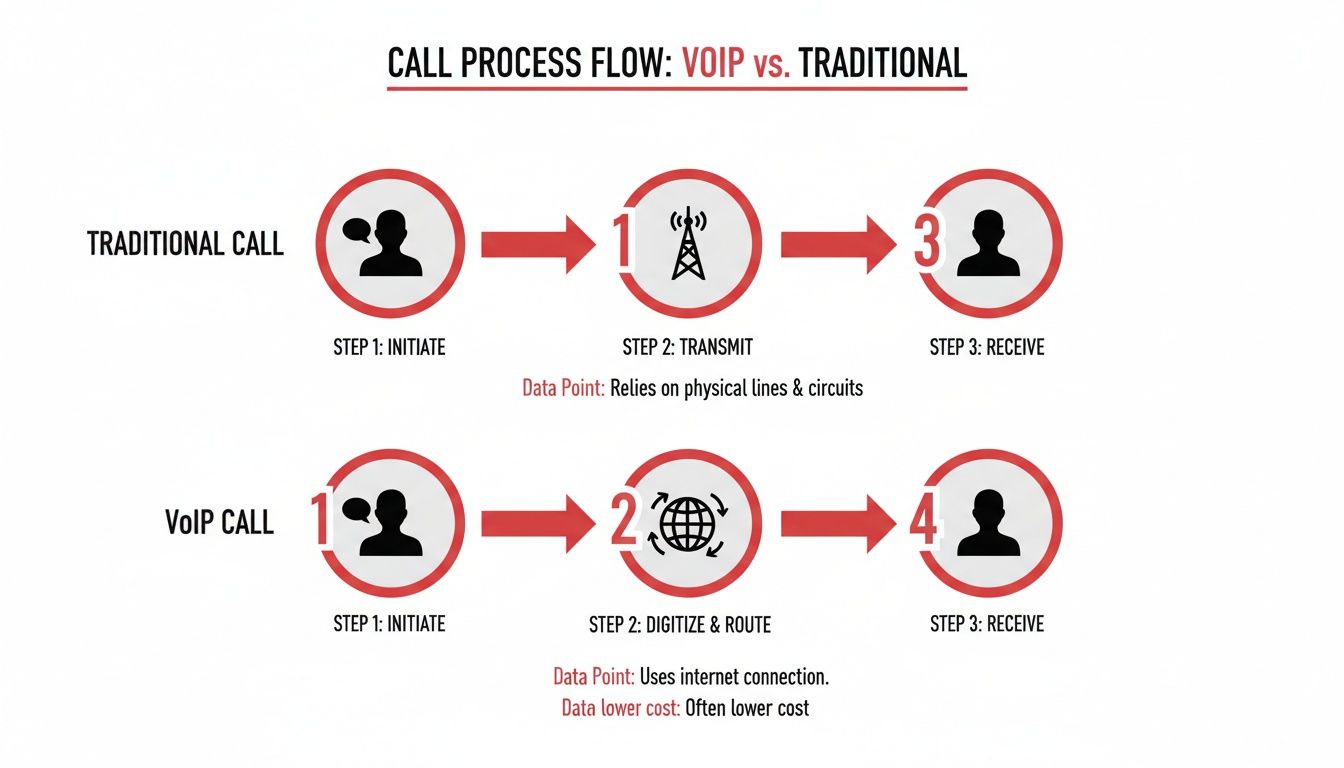
The big takeaway? VoIP completely bypasses the expensive, tangled mess of physical phone lines. It just uses the internet to connect you to anyone, anywhere.
Once your voice is digitized, it's chopped up into tiny, manageable pieces called data packets. Think of these like a stack of postcards, where each card has a small piece of your sentence written on it. Each postcard is individually addressed and sent on its way.
This method is incredibly smart. Instead of needing a constant, open line between you and the person you're calling, VoIP sends these packets through whatever path is fastest at that moment. On the other end, the packets are instantly reassembled in the right order, turned back into sound, and played for the listener—all in a split second.
For this to work without eating up all your internet bandwidth, your voice data needs to be compressed. This job is handled by something called a codec (short for coder-decoder). You can think of a codec as a specialized translator for your voice.
Some codecs focus on HD audio quality, while others are great at using very little data, which is perfect if you have a slow connection. A good VoIP service will automatically pick the best codec for the job without you having to do a thing.
So how do all these packets know where to go? And how does the call even start? That’s managed by a protocol, usually the Session Initiation Protocol (SIP). Think of SIP as the digital traffic cop for your VoIP call.
SIP’s job isn't to carry the sound itself. Its role is to set up the call, manage it while you're talking, and end it cleanly when you hang up. It's the digital handshake that says, "Hey, I'd like to start a call," makes sure everyone is ready, and then says goodbye.
Without SIP, your voice packets would be like letters with no address—lost and going nowhere. It’s the behind-the-scenes hero that makes your calls just work.
Finally, two things determine whether your call sounds amazing or like a garbled mess: latency and jitter.
Professional VoIP providers use smart technology to crush both latency and jitter, making sure your voice packets arrive fast and in the right order. The result is a smooth, clear conversation, whether you're calling across the street or across an ocean.
Let's be honest—the number one reason people ditch their old phone plans for international calling VoIP is the jaw-dropping cost savings. It’s not a small difference; it’s a total game-changer.
Traditional phone companies built their pricing on a complex and expensive web of physical wires and international carrier agreements. VoIP completely sidesteps that ancient model by running your calls over the internet—a network you’re likely already paying for. This isn't just about saving a few cents here and there. For small businesses, we're talking about slashing international call costs by as much as 90%.
That kind of savings is why the VoIP market is exploding, projected to rocket from $193.73 billion in 2025 to over $540.96 billion by 2032. International calling is a huge piece of that growth.
Unlike the rigid, take-it-or-leave-it plans from legacy carriers, VoIP services offer flexible pricing that actually makes sense for how you call. Figuring out which one fits you is the first step toward seeing just how much you can save.
Most providers use one of these three approaches:
The real beauty of VoIP pricing is its flexibility. You’re no longer forced into a one-size-fits-all box. You can pick a model that mirrors your actual needs, so you never pay for minutes you don't use.
Let's make this real. Say you need to call a supplier's landline in the United Kingdom. With a traditional carrier, you might be looking at a rate of $0.50 per minute. A single one-hour strategy call would set you back a painful $30.
Now, let's make that same call with a VoIP service. The rate could be as low as $0.02 per minute. That exact same one-hour call now costs you just $1.20. You just saved over 95% on a single call.
For teams making these calls every week, the savings add up to thousands of dollars a year. If you're ready to see this in action, check out our guide on how to make international calls and start saving.
To see just how dramatic the difference is, let's compare some common international destinations. The table below shows typical per-minute rates from a traditional landline carrier versus a standard VoIP service.
| Destination Country | Average Traditional Rate (per minute) | Average VoIP Rate (per minute) | Potential Savings per Hour of Calling |
|---|---|---|---|
| United Kingdom | $0.50 | $0.02 | $28.80 |
| India | $1.00 | $0.019 | $58.86 |
| Mexico | $0.75 | $0.019 | $43.86 |
| Philippines | $1.50 | $0.15 | $81.00 |
| Australia | $0.90 | $0.03 | $52.20 |
The numbers don't lie. For every single hour spent on an international call, you could be saving anywhere from $28 to over $80. Over the course of a year, that's enough to fund a new marketing campaign or reinvest in your team.
The savings don't stop at the per-minute rate. When you switch to VoIP, you're also cutting out all the hidden fees and operational headaches that come with old-school phone systems.
VoIP gets rid of the need for:
By moving your communications to the cloud with VoIP, you're not just getting cheaper calls. You're shedding the financial dead weight of an outdated technology, freeing up cash and resources to focus on what really matters.
When you’re saving a bundle on international calls, it’s natural to wonder, "What's the catch?" Many people assume that switching to VoIP means sacrificing call quality or security. But that’s an outdated idea. Modern VoIP isn’t just about being cheaper; it’s designed to deliver conversations that are both crystal-clear and completely private.
The proof is in the numbers. VoIP is expected to have over 1 billion users globally by 2025. This isn't just a niche technology anymore; it's a mainstream communication standard. That massive growth, with the market projected to jump from $132.2 billion in 2024 to $349.1 billion by 2034, is built on a foundation of reliability and trust. For a deeper dive, check out these trends shaping the future of VoIP.
Ever been on an internet call that sounded perfect, and another that was a choppy mess? It’s not random. It all boils down to your internet connection and the tech managing the call. Think of your internet connection like a highway for your voice. For a smooth ride, you need enough lanes for traffic (bandwidth) and a road with no potholes or traffic jams (network stability).
Here are the three big factors that make or break your call quality:
A professional VoIP service uses clever technology behind the scenes to actively manage latency and jitter, making sure your conversation sounds natural, not like a bad sci-fi movie.
Okay, so the quality is there. But what about security? It’s a fair question. When your voice is traveling over the internet, you want to know that no one is listening in. This is where a professional VoIP service truly stands apart from many free apps.
Reputable providers treat your conversations like a bank treats your money—with serious security. They use powerful, end-to-end encryption to lock down your calls.
Encryption basically wraps your conversation in an unbreakable digital envelope. Even if a hacker managed to grab the data, all they would see is scrambled, useless code.
This is made possible by two key security protocols working in tandem:
Together, these technologies create a secure tunnel for your call, making it safe enough for even the most sensitive business discussions. It's a level of protection you simply can't assume you're getting with consumer-grade apps—the same ones that often can't even connect to a regular phone number. To understand that gap better, see why WhatsApp can't call landlines and how a dedicated VoIP service is different.
This is where the rubber meets the road. The true power of international calling VoIP isn't just in the technology—it’s in how it solves real problems for real people. It’s a tool that closes the gap between families, helps small businesses go global, and lets remote teams work like they’re in the same room.
And people are catching on. The global VoIP market is expected to jump from $145.7 billion in 2024 to $161.79 billion in 2025. For small businesses, the savings are staggering—many cut their international calling costs by up to 90%. The market is on track to hit $415.20 billion by 2034, completely changing how we connect. You can dig deeper into these trends with these VoIP statistics and their market impact.

On a personal level, VoIP is all about connection. Before, calling family abroad meant watching the clock, knowing every minute was adding up on a massive phone bill. Heartfelt conversations were cut short by cost.
VoIP completely erases that problem. Think of a student in London calling their parents back in Sydney for just a few pennies a minute. Or a grandparent in Mexico City chatting with their grandkids in Toronto for hours without a second thought about the bill. Mobile VoIP apps make it as easy as a regular call, just without the painful price tag.
Today's gig economy has no borders, and freelancers need tools that can keep up. A graphic designer in Lisbon might have clients in New York, London, and Singapore. To them, international calling VoIP isn't a luxury; it's a lifeline for building and keeping those relationships.
Here’s why it’s a game-changer for them:
For an SME, VoIP is a growth hack. It lets them play on the global stage without the budget of a multinational corporation. A small e-commerce shop, for instance, can instantly create a local presence in several countries at once.
VoIP levels the playing field. A small business can offer local customer support in the UK, a sales line in Australia, and a supplier contact in Germany—all run by one team from a single office. This makes the company feel like a bigger, local operation, which builds a huge amount of customer trust.
Imagine a business that sources materials from Vietnam and sells to customers in Canada. VoIP lets their procurement team negotiate with suppliers and their sales team follow up on leads without running up huge bills. Features like call recording are also gold for training and quality control. If you’re weighing your options, our roundup of the best international calling apps is a great place to start.
When your team is spread across different continents, communication is the glue that holds everything together. VoIP is the backbone of modern remote work, giving distributed teams the tools they need to collaborate seamlessly.
A software company with developers in India, marketers in the US, and a head office in Germany depends on VoIP for everything from daily stand-ups to client demos. This is where advanced features become critical:
Ready to make the switch? Moving to VoIP for your international calls is surprisingly simple and can start saving you money right away. Here’s a quick checklist to get you from where you are now to making your first crystal-clear call in minutes.
The whole system runs on your internet, so that's the first place we'll look.
Before you do anything else, take a quick look at your internet speed and stability. VoIP doesn't eat up a ton of data, but it hates an inconsistent connection—that’s what causes annoying call jitter or dropped calls. A quick online speed test will tell you everything you need to know.
For smooth, clear audio, you'll want a steady 100 Kbps (that's just 0.1 Mbps) for both uploads and downloads for each call. Honestly, most modern broadband connections blow past this, but it's always smart to double-check.
You don't need a bunch of fancy, expensive gear to start. You’ve got options.
The real beauty of modern VoIP is how easy it is to access. With a service like YodelPhone, your web browser is your phone. There’s nothing to download or install, which means no technical headaches. You can literally start calling in seconds.
Now, pick a provider that fits what you actually need. Think about which countries you call the most, whether you prefer to pay-as-you-go or get a subscription, and what extra features might be useful.
Once you sign up, getting started is usually a piece of cake. For a browser-based service like YodelPhone, it’s instant. You just create an account, add a few dollars in credit, and you’re ready to dial any number in the world. This is perfect for a small business needing to get a remote team up and running fast, without shipping hardware or dealing with a complicated setup. It’s a real, practical solution for staying connected globally.
Even with all the benefits laid out, you probably have a few practical questions spinning in your head. That’s perfectly normal. Let's tackle the most common ones so you can feel confident about making the switch.
Nope, not unless you want to. While you can certainly use a dedicated VoIP desk phone (often called an IP phone), most people get started with softphones.
A softphone is just an app you install on your computer, smartphone, or tablet. It turns the device you already own into a powerful international calling machine. All you really need is a decent internet connection and maybe a headset for the best audio. It’s the fastest way to get started with zero extra hardware costs.
For most people, the answer is a big yes. The process is called number porting, and it lets you move your existing landline or mobile number over to a VoIP service. This is a must-have for any business that’s built its brand around an established phone number. You get all the benefits of VoIP without confusing your customers.
Before you sign up, always double-check with your provider about their specific porting process. Ask about timing and any potential one-time fees to make sure everything goes off without a hitch.
This is a really important one. Traditional landlines are tied to a physical address, which is how emergency services instantly know where you are. Since VoIP works over the internet, it can be used from anywhere, so it handles 911 a bit differently.
Reputable providers solve this with a service called Enhanced 911 (E911). When you first set up your account, you’ll register a physical address. If you ever dial 911, that address is automatically sent to the emergency dispatcher. Just make sure your provider offers E911 and remember to update that address if you move.
When your internet is solid, VoIP call quality can be just as good—and often even better—than your old landline. Many services now offer crisp high-definition (HD) audio that makes conversations sound like you're in the same room.
The key ingredient is a stable, high-speed internet connection. If your connection has enough bandwidth and low latency (meaning, no major delays), your calls will be crystal-clear. The good news is that most modern broadband plans are more than powerful enough to handle VoIP traffic without breaking a sweat.
Ready to see how simple and cheap browser-based international calling can be? YodelPhone connects you in seconds with no downloads, contracts, or headaches. Grab your one-minute free trial right now and discover how easy global communication should be.

Uncover what is VoIP and how does it work with this clear, step-by-step guide. Learn the basics, benefits, and how to start making calls over the internet.

Discover how international VoIP calls can save you money and simplify global communication. Learn how they work and how to get started in minutes.

Discover voip international calling that delivers clear, affordable global calls from your browser. Learn pricing, setup, and start saving today.

Unlock affordable global calling with a pay as you go international phone service. Learn how to save on calls without contracts or hidden fees.