
voip international calling
Voip International Calling: Clear, Affordable Global Calls from Your Browser

If you’ve ever winced at a sky-high phone bill after calling family or clients overseas, you know the pain of old-school international calls. For decades, calling abroad meant using the Public Switched Telephone Network (PSTN)—a clunky, expensive system of physical copper wires. Every single minute cost a premium, turning global conversations into a luxury.
VoIP, or Voice over Internet Protocol, completely flips that script.
Instead of those ancient phone lines, VoIP uses your internet connection to make calls. It’s the same basic idea behind services like Skype or WhatsApp, but professional platforms like YodelPhone supercharge it for business-grade clarity, letting you call any number in the world—landline or mobile—right from your browser.
So, how does this all work? Let's break it down.
Think of it like this: A traditional phone call is like sending a package via a dedicated, expensive courier. They charge you for every mile and every minute it's in transit. It’s reliable, but it costs a fortune.
VoIP international calling is like attaching that same package to an email and hitting "send." It zips across the internet—an existing, massive, and incredibly efficient network—and arrives at its destination almost instantly for a tiny fraction of the cost.
This digital-first approach delivers some serious advantages right out of the gate:
VoIP isn't just a cheaper way to call; it's a smarter, more flexible way to communicate. It cuts the cord from physical lines, making the world feel a whole lot smaller.
Here’s a quick rundown of how the two methods stack up.
| Feature | Traditional Phone Lines (PSTN) | VoIP International Calling |
|---|---|---|
| Technology | Physical copper wires, switching stations | Digital data packets over the internet |
| Cost | High per-minute rates, monthly plans | Extremely low pay-as-you-go rates |
| Hardware | Desk phone or mobile device required | Works from any browser (PC, phone) |
| Flexibility | Tied to a physical location or SIM card | Call from anywhere with internet |
| Setup | Requires carrier plan and activation | Sign up and call in under 60 seconds |
It's a night-and-day difference. One is stuck in the past, and the other is built for how we live and work today.
This massive shift to internet-based calling is completely changing the game. The global market for international calls, now dominated by VoIP, was valued at USD 1.44 billion in 2024 and is expected to hit USD 2.29 billion by 2032.
The first step to unlocking these benefits is simply understanding the right way to dial. To get the formatting right, check out our complete guide on how to call international numbers. Once you have that down, you'll see exactly why millions are ditching their old phone systems for good.
Ever wonder how your voice zips across oceans and continents in a split second during a VoIP international calling session? It feels like magic, but it’s really just a smart combination of digital processes working together seamlessly behind the scenes. This system is what lets you bypass those expensive traditional phone networks entirely.
Let's pull back the curtain and look at the core components that make your global conversations happen.
This diagram breaks down the basic journey of a VoIP call, from you to the person you're calling.
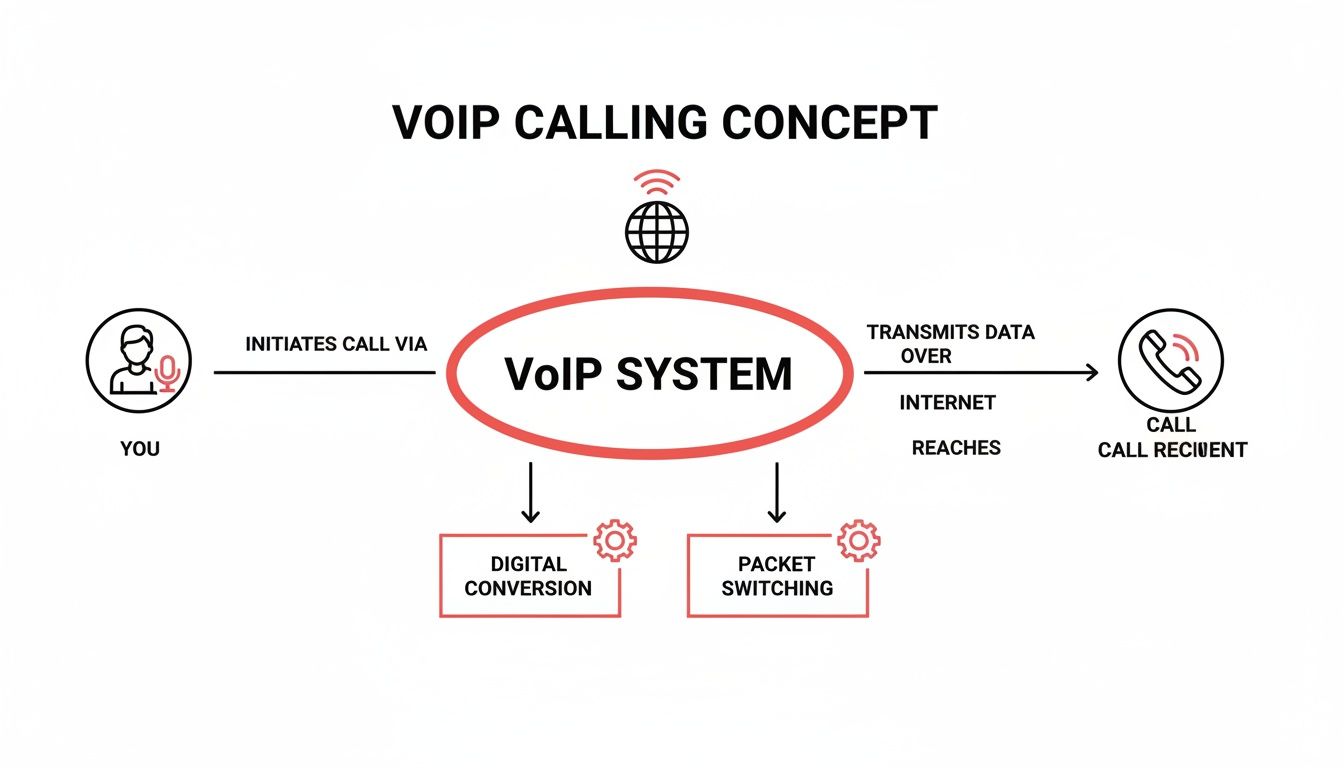
As you can see, your voice is converted into digital data, sent over the internet in tiny packets, and then reassembled on the other end—all in near-real-time.
At the heart of every VoIP call, you'll find codecs. Think of a codec (short for coder-decoder) as a highly skilled translator for your voice. When you speak, you create an analog sound wave, but that wave can't travel over the internet. It needs to be converted into a compact digital format first.
The codec’s first job is to compress this audio data. It cleverly strips out redundant information, making the data packet much smaller and easier to send quickly over your internet connection. This is what keeps your call clear and uninterrupted without hogging all your bandwidth.
Once the data reaches its destination, the codec on the other end instantly decompresses the packet, rebuilding it into the original analog sound wave. It all happens so fast that it just sounds like a normal conversation.
A high-quality codec is the difference between a choppy, robotic call and a crystal-clear conversation that sounds like you’re in the same room. It’s the unsung hero of great call quality.
While codecs handle the audio itself, another piece of technology manages the call from start to finish. This is the Session Initiation Protocol (SIP). Imagine SIP as the ultimate air traffic controller for your phone calls. It doesn't carry your voice, but it handles all the critical signals needed to make the call happen.
When you dial a number, SIP is responsible for:
In short, SIP is the logistical mastermind that ensures your call starts, runs smoothly, and ends correctly. Your call wouldn't even get off the ground without it.
So how do services like YodelPhone let you make a VoIP international calling connection right from your web browser with zero downloads? The secret is WebRTC (Web Real-Time Communication).
WebRTC is an open-source technology built directly into modern browsers like Chrome, Firefox, and Safari. It allows your browser to establish a direct, peer-to-peer connection for sending audio and video without needing any plugins or external software.
This is a game-changer. Instead of downloading and installing a dedicated app, you can just visit a website, log in, and start dialing. It removes all the old friction, making global communication as easy as opening a new tab. This browser-first approach is why so many of the best international calling apps now prioritize simplicity and instant access.
Together, these three technologies—codecs, SIP, and WebRTC—form the powerful engine that drives modern VoIP, delivering clear, reliable, and incredibly affordable calls across the globe.
The promise of massive savings is what gets most people interested in VoIP international calling, but what does that actually look like on your bill? Understanding the different ways VoIP services charge is the key to getting the best value, whether you're calling family once a month or running a global sales team.
Unlike old-school phone plans with their confusing contracts and sneaky hidden fees, VoIP pricing is usually much more straightforward. The whole point is to give you flexibility and transparency, so you only pay for what you actually use. It's a huge shift from the old model of being locked into expensive, rigid monthly plans.
Most modern VoIP providers, including YodelPhone, build their pricing around one of three simple models.
1. Pay-As-You-Go (PAYG)
This is by far the most flexible and honest model out there. You just add credits to your account and they get used up as you make calls. Each call is billed per minute at a clear, set rate for whatever country you're calling, and the cost is simply deducted from your balance. No surprises.
If that kind of flexibility sounds good to you, it's worth exploring the benefits of pay-as-you-go international calling to see how it fits your lifestyle.
2. Monthly Subscriptions
Some providers offer monthly plans that come with a bundle of international minutes to certain countries or regions for a flat fee. These are really designed for people who have consistent, high-volume calling habits to the same few places.
3. Custom Enterprise Plans
For big organizations or call centers with really specific needs, providers can put together custom-quoted plans. These might include a mix of unlimited calling zones, dedicated support, and other advanced features built just for that business's operations.
The real power of VoIP pricing is its adaptability. You're no longer forced into a one-size-fits-all plan designed to benefit the phone company; instead, you get to choose a model that perfectly matches how you actually communicate.
To see just how big the cost difference is, let's put some numbers side-by-side. Here’s how typical pay-as-you-go VoIP rates stack up against the average costs from a traditional mobile carrier. The savings become obvious right away.
Here's a comparative look at the average per-minute cost of calling popular international destinations using different methods.
| Destination Country | Typical Traditional Carrier Rate | Example VoIP Pay-As-You-Go Rate |
|---|---|---|
| United Kingdom | $0.50 - $1.50 per minute | $0.02 - $0.04 per minute |
| India | $0.75 - $2.00 per minute | $0.02 - $0.05 per minute |
| Mexico | $0.40 - $1.00 per minute | $0.03 - $0.06 per minute |
As the table shows, the savings are often well over 90%. A 30-minute call to the UK that might cost you $30 with a traditional provider could cost as little as $0.60 with VoIP. Over a year, that adds up to hundreds, or even thousands, of dollars back in your pocket.
While VoIP is generally more transparent, it still pays to be a smart consumer. When you're picking a provider, look for clear and upfront information on any potential extra costs.
The single most important thing is transparent per-minute rates. A trustworthy provider will have a simple, easy-to-find list of their rates for every country, so you know exactly what you’ll be charged before you even dial. Avoid any service that hides its pricing behind a sign-up form or buries it in complex terms of service.
That kind of clarity means you can manage your budget with confidence, without any surprise charges, making VoIP international calling a truly predictable and cost-effective way to stay connected.
It’s easy to get lost in the tech specs and pricing charts, but VoIP international calling really comes alive when you see who is using it and why. This isn't just a clever way to save a few bucks; it's a genuine bridge connecting people and businesses across the globe.
Think of it this way: for a family split between continents, it’s the difference between a rushed, expensive phone call and a long, relaxed conversation. For a startup, it's the key to looking like a global player overnight. The reasons people switch are as varied as the people themselves. Let’s dive into a few real-world scenarios.
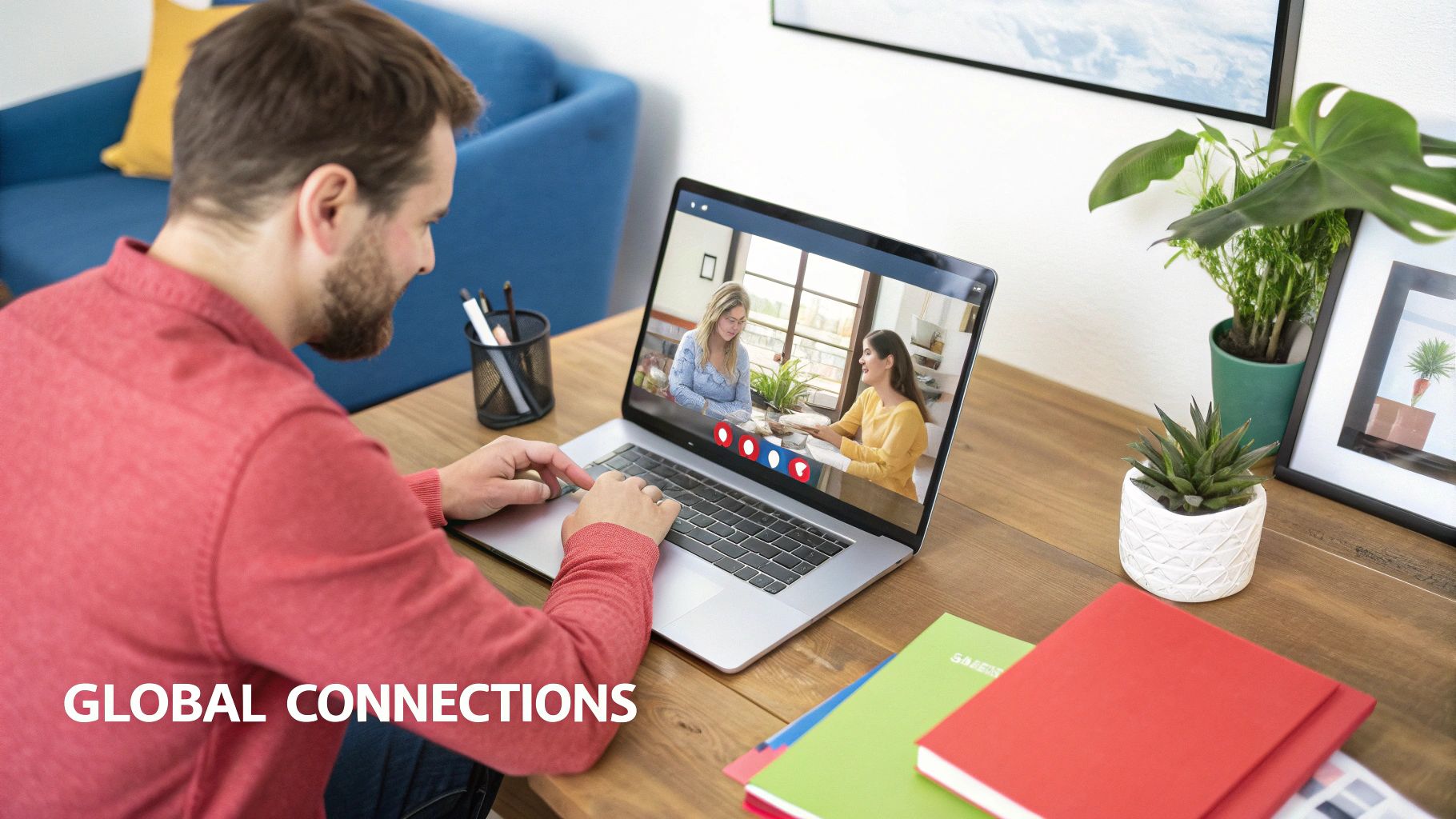
For families with loved ones living abroad, staying in touch used to mean one thing: watching the clock. Expensive calling cards and sky-high per-minute rates from traditional carriers made every conversation feel like a race against a massive bill. VoIP flips that script entirely.
Imagine a daughter in New York calling her parents' landline in Mumbai. Instead of punching in a long PIN from a calling card, she just opens her browser, dials their number on a service like YodelPhone, and talks. An hour-long weekly chat can cost less than a cup of coffee. It’s not about making cheap calls; it’s about making connection affordable.
This is the heart of VoIP's personal appeal: it removes the financial barrier to staying close.
Want to compete with the big guys? You need to look like you belong. For a small business, showing up as a "local" to international customers is a massive advantage, but opening an office overseas is out of the question. This is where VoIP becomes a secret weapon.
A small e-commerce shop in the United States can buy a local UK phone number for a few dollars. When a customer in London dials that number, the call is instantly routed to the support team in the US. The customer gets a familiar, local experience, and the business projects a professional, global image. It's an incredibly simple way to build trust in a new market.
Today’s teams are spread out everywhere. A project manager in Germany needs to sync with developers in Brazil and a marketing lead in Canada. Clear, affordable, and easy communication isn't a luxury—it's essential.
VoIP makes this happen without the usual friction. Features built for distributed teams are a game-changer:
The demand for these tools is exploding. The VoIP services market was valued at US$ 178.89 billion in 2025 and is on track to hit US$ 413.36 billion by 2032. For remote teams, the flexibility of pay-as-you-go models is a perfect fit. You can find more details about the growing VoIP market on coherentmarketinsights.com.
If you’re a freelancer, your clients could be anywhere. A graphic designer in Spain might be juggling projects for clients in Australia, the US, and South Africa. Every interaction needs to be professional and seamless to keep those relationships strong.
For a freelancer, every call is a reflection of their brand. VoIP provides the tools to manage client communication professionally and cost-effectively, from anywhere in the world.
Here’s how VoIP helps them punch above their weight:
In every one of these cases, VoIP international calling is more than just a utility. It’s a tool that strengthens personal bonds, fuels business growth, and powers the flexible, global way we live and work today.
Think of this as your buyer's checklist. It’s designed to help you look past the flashy marketing and find a provider that actually delivers on its promises.
The single most important factor is how the call actually sounds. Don’t settle for anything less than HD (High-Definition) audio. This is what separates modern VoIP from the choppy, echo-filled internet calls of the past, ensuring your conversations are always crystal-clear.
Just as crucial is security. Your conversations are private, and they need to stay that way. A trustworthy provider will use end-to-end encryption to shield your calls from anyone trying to listen in. This gives you peace of mind whether you're catching up with family or talking business.
The whole point of VoIP is to save money, but that only happens if the pricing is dead simple. The best providers use a straightforward pay-as-you-go model. No subscriptions, no hidden fees, and no confusing contracts to trap you.
Before you sign up, check if you can easily find a detailed, per-minute rate list for every country. If a provider makes you hunt for this information, it's a huge red flag. You should know exactly what you’ll pay before you dial.
Your ideal VoIP provider won't just promise low rates; they'll provide a clear, upfront breakdown of costs for every destination. Simplicity in pricing is a strong indicator of a trustworthy service.
The right tools can make all the difference. As you compare services, think about what will make your life easier:
Finally, a great service is one that’s easy to use and has your back when you need help. Look for providers that offer a free trial without asking for a credit card. This shows they’re confident in their product and lets you test everything—call quality, features, the interface—completely risk-free.
Also, check out their customer support. Is there a live chat? A detailed help center? A provider that makes it easy to get answers is one that actually values its customers. By running through this checklist, you can confidently pick a VoIP international calling provider that delivers clear, secure, and affordable calls every single time.
Alright, you've seen how VoIP international calling works and why it’s so much cheaper. Now for the fun part: actually making a call. The best part about modern, browser-based platforms is the speed. Seriously, you can go from reading this article to calling a friend in another country in less time than it takes to brew a cup of tea.
This quick guide will walk you through just how simple it is. No confusing tech, no long waits.
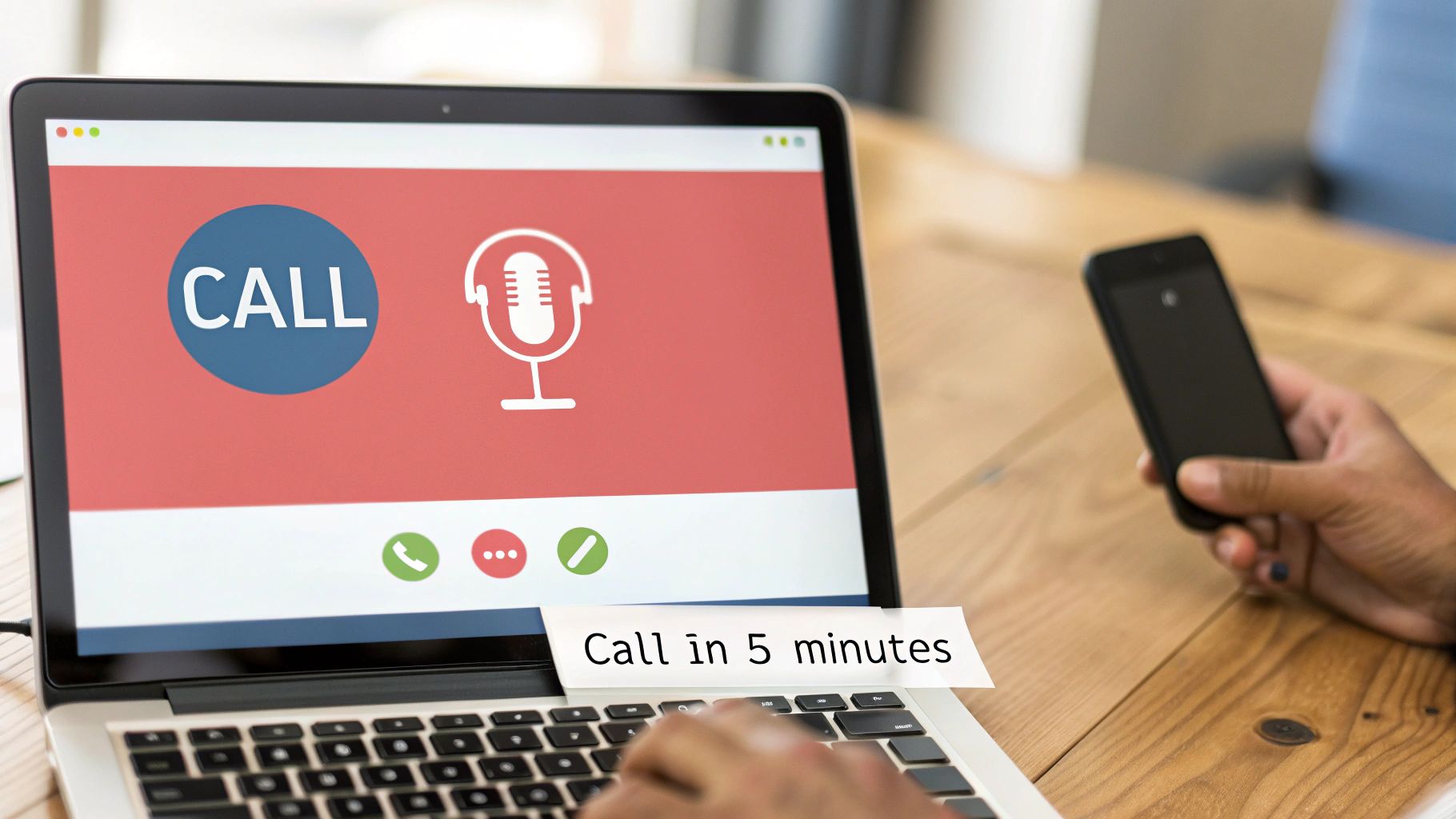
Getting set up is almost comically fast. Most modern services, like YodelPhone, have ditched the clunky software downloads and endless sign-up forms. The whole point is to get you talking immediately.
Sign Up in Seconds (No Credit Card Needed): The first step is usually just entering your email. The best providers will give you a free trial without demanding your payment info upfront—that’s a huge sign of confidence. It means you can test the call quality with zero risk.
Add Credits Securely: Once you’re happy with the quality and ready to talk longer, you just add some credits. This pay-as-you-go approach puts you in total control. Pick an amount, pay with a card, and the balance hits your account instantly.
Dial Your First International Number: This is it. Dialing an international number follows a universal format: Exit Code + Country Code + Local Number. For example, if you’re in the U.S. and calling a landline in London, you’d dial 011 (U.S. exit code), then 44 (the UK’s country code), and finally the local number.
The real magic of browser-based VoIP is its simplicity. No installations, no complex settings, no waiting. You can sign up, add five bucks, and place a call from your laptop or phone right now.
Even with a dead-simple process, little hiccups can happen. Here’s how to squash the most common ones so your VoIP international calling experience is flawless from the get-go.
Microphone Not Working? Check Permissions. Your web browser is designed to protect your privacy, so it needs your permission to use your microphone. If the other person can't hear you, look for a tiny microphone icon in your browser's address bar. Click it and choose "Always allow" for the site you're using. A quick page refresh usually fixes it right up.
Choppy Audio? Check Your Connection. Call quality is tied directly to your internet stability. If your call sounds robotic or keeps cutting out, try moving closer to your Wi-Fi router. Better yet, plug in with an Ethernet cable if you can. A quick speed test will tell you in seconds if a slow connection is the culprit.
By following these simple setup and troubleshooting tips, you’re ready to go. You'll be connected and talking in just a few minutes, with clear, affordable global calls right at your fingertips.
Thinking about making the switch to VoIP for your international calls? It's natural to have a few questions. Let's clear up some of the most common ones we hear.
Yes, you absolutely can. One of the best things about a service like YodelPhone is that it connects you to any phone number in the world, whether it's a mobile or a traditional landline.
The person you're calling doesn't need to download an app, have a smartphone, or even be connected to the internet. They just answer their phone like they always do. It’s a seamless way to replace your old, expensive calling methods.
The short answer is yes, as long as you have a stable internet connection. The days of robotic, choppy internet calls are long gone.
Modern VoIP services use advanced HD audio technology and powerful infrastructure to deliver call quality that's crystal-clear—often even better than a standard mobile call.
Your internet connection is the key. A decent broadband, 4G, or 5G signal is all it takes to get a flawless calling experience.
Nope, not at all. For a browser-based platform like YodelPhone, you don't need any special hardware.
All you need is a device with a modern web browser (like your laptop, tablet, or smartphone) and a microphone. This is a huge advantage, saving you from buying expensive VoIP phones and letting you start calling instantly.
Ready to see how clear and affordable modern international calling can be? YodelPhone gets you started in seconds with no downloads or contracts. Try YodelPhone for free and make your first call today.

Uncover what is VoIP and how does it work with this clear, step-by-step guide. Learn the basics, benefits, and how to start making calls over the internet.

Discover how international VoIP calls can save you money and simplify global communication. Learn how they work and how to get started in minutes.

Unlock affordable global calling with a pay as you go international phone service. Learn how to save on calls without contracts or hidden fees.

Discover how the international phone number for business can unlock global growth. Learn its benefits and how to choose the right provider.