
how to make international calls cheaply
How to Make International Calls Cheaply and Easily

Tired of your phone bill skyrocketing every time you call someone abroad? The simplest fix is to skip your traditional carrier and use a browser-based, pay-as-you-go VoIP service.
These platforms let you call any landline or mobile number on the planet directly from your computer or phone. No downloads, no subscriptions, and no nasty surprises on your bill.
For years, connecting with family, friends, or clients overseas meant choosing between two bad options: your mobile carrier's ridiculously expensive international plans or those clunky, fee-ridden calling cards. It was a headache.
Thankfully, those days are over. The solution is Voice over Internet Protocol (VoIP) technology, which basically means making calls over the internet instead of old-school cellular networks.
This one simple shift slashes costs and gets rid of all the unnecessary hoops you used to have to jump through. Forget signing contracts or getting locked into monthly plans you barely use.
The real magic is in platforms that work entirely from your web browser. A service like YodelPhone nails this approach, getting you connected in seconds without any fuss.
Here’s why it works so well:
This isn't just a niche trick; it's a massive shift in how the world communicates. People are fed up with old, expensive calling methods, and the market is booming with better internet-based solutions.
The global international call services market was recently valued at USD 1.44 billion and is expected to hit USD 2.29 billion by 2032.
This growth isn't just a bunch of numbers—it represents millions of people ditching their pricey phone plans for smarter, internet-powered alternatives. You can see more data on this trend from Data Bridge Market Research. By making the switch, you're not just saving money; you're adopting a better way to stay connected.
Before diving into the step-by-step process, it helps to see all your options in one place. This table breaks down the most common methods for making international calls, so you can quickly see which one fits your needs best.
| Calling Method | Best For | Typical Cost Structure | Key Advantage |
|---|---|---|---|
| Browser-Based VoIP | Occasional or frequent callers who want flexibility and no subscriptions. | Pay-as-you-go per minute. | No downloads, no subscriptions, transparent pricing. |
| Mobile Carrier Add-Ons | People who prefer using their native phone dialer for convenience. | Monthly fee + per-minute rates. | Convenience of using your existing phone number directly. |
| Subscription VoIP Apps | Heavy users calling specific countries frequently. | Monthly subscription for a bundle of minutes. | Can be very cheap per minute if you use all the minutes. |
| "Free" Calling Apps | Calling other users who have the same app and a smartphone. | Free (app-to-app calls). | No cost for calling other app users. |
| Physical Calling Cards | People without regular internet access or a bank account. | Pre-paid card with a set number of minutes. | No bank account needed; can be bought with cash. |
As you can see, browser-based VoIP offers a powerful combination of flexibility, transparency, and low cost that's hard to beat for most people. Now, let's get into how you can start using it to save money.
The key to making cheap international calls isn't some complicated tech hack. It's just about picking the right tool for the job. With so many options out there—from your old-school carrier plan to a dozen different apps—it's easy to feel overwhelmed. Let's cut through the noise and figure out what actually makes sense for you.
This decision tree gives you a quick visual of when to stick with a traditional carrier versus when it's time to switch to a more modern VoIP solution.
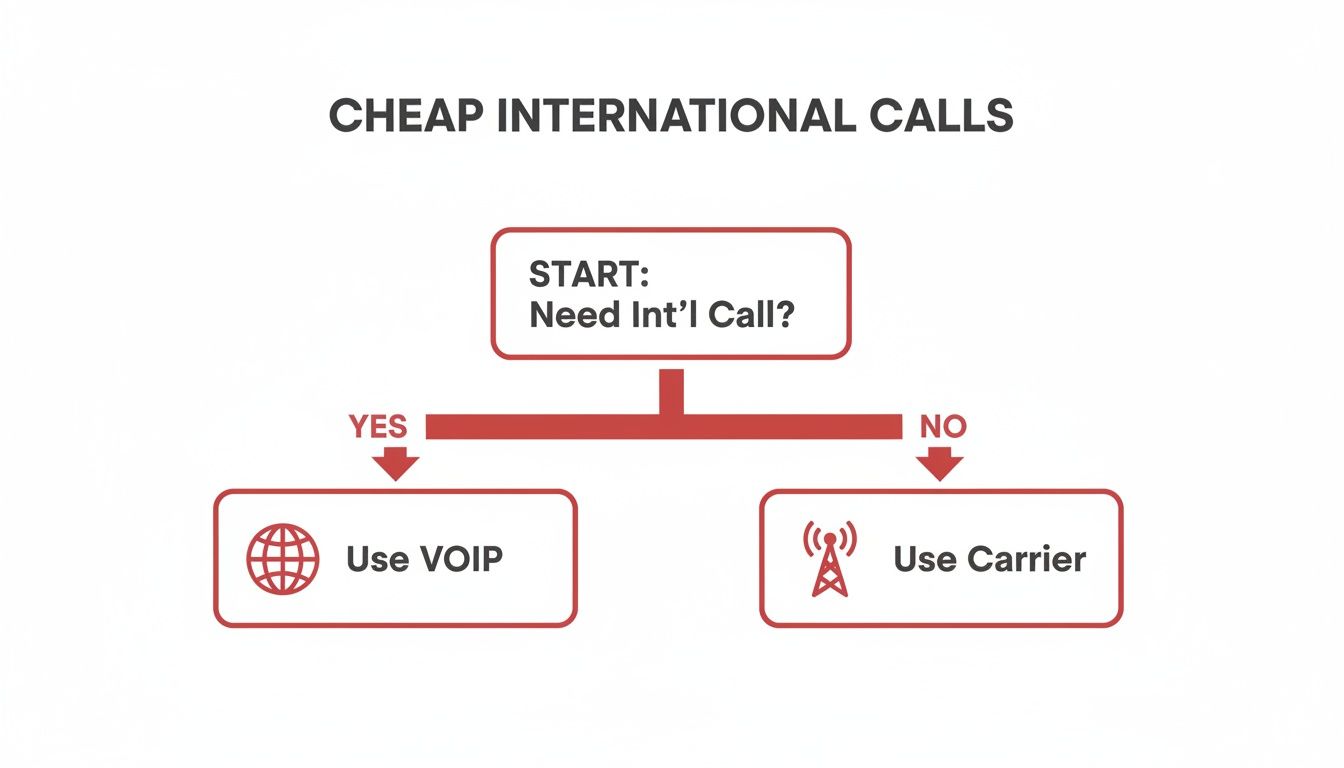
The flowchart makes one thing clear: if you need to make dedicated international calls, internet-based services (VoIP) are almost always the way to go.
Sure, your mobile carrier has an international calling plan. It’s convenient—you just dial from your phone like any other call—but you pay dearly for that convenience. These plans usually hit you with a monthly fee right off the bat, and then pile on per-minute rates that are still shockingly high.
And what about those physical calling cards you used to see at the corner store? They’ve mostly lost their appeal for a reason. They’re notorious for hidden costs like "connection fees," rounding up your minutes, and expiring credits. They’re a gamble, not a strategy for saving money.
Many popular calling apps push a monthly subscription model, offering a bundle of international minutes for a flat fee. This can work out if you’re constantly calling one specific country and you always use up all your minutes. But that's a big "if."
The major downside is the lack of flexibility. What happens when you have a quiet month and barely make any calls? You still pay the full subscription. For most people whose calling needs fluctuate, it's just wasted money. For a deeper dive, check out our guide on the best international calling apps available today.
This is where you find the real savings. Browser-based platforms like YodelPhone run on a simple pay-as-you-go model. No monthly fees, no contracts, no nonsense. You just add credits to your account and pay only for the minutes you actually talk. The rates are often just a tiny fraction of what traditional carriers charge.
There's a reason the market for these solutions is booming. The global international calling apps market was recently valued at around USD 30 billion and is expected to keep climbing. This isn't just a niche trend; it's a massive shift away from expensive, outdated calling methods toward flexible, internet-based options.
Key Takeaway: For most people, the pay-as-you-go model offers the perfect blend of low cost, transparency, and flexibility. You get some of the lowest rates on the market without being locked into a subscription.
Let's look at how this plays out for different people:
The biggest win with browser-based platforms is how easy they are to use. There are no apps to install, no software to update, and no long-term commitments. You can sign up, add a few dollars of credit, and be making cheap international calls in under a minute from any device with an internet connection. It’s the smartest choice for anyone who values both their time and their money.
Ready to connect? Making your first cheap international call with a browser-based service is surprisingly simple. Forget complicated setups or confusing apps—you can be talking to someone on the other side of the world in just a few minutes, right from your computer.
Let's walk through the process using a platform like YodelPhone. You'll see just how easy it is to get started, dial correctly, and keep your costs completely transparent.
The best part about browser-based platforms is how fast you can get going. There's nothing to download or install, which means you can sign up and make a call almost instantly.
Most services, including YodelPhone, offer a free trial without even asking for a credit card. This lets you test the call quality and see how it works firsthand, ensuring it's the right fit before you spend a dime. The sign-up is usually just an email and password, and you’re in.
This is where most people get tripped up, but it's much simpler than it looks. An international number has three basic parts, and getting them right ensures your call connects on the first try.
+44 7....Real-World Example: Let’s say you need to call a mobile number in London, which is
07912 345678.
In the dialer, you would enter it as:+44 7912 345678.
You've just replaced the leading "0" with the+44prefix. It’s that easy.
For a deeper dive, our guide on how to call international numbers breaks down the formats for dozens of countries.
A core benefit of pay-as-you-go services is total cost transparency. Before you even hit the call button, you should see the exact per-minute rate for the number you're dialing.
Good platforms display this rate clearly on the screen as you type. This means you always know what you're paying, and there's no fear of bill shock. If you're calling a mobile in France, you'll see one rate; switch to a landline in Brazil, and the rate updates instantly.
Once you know the cost, you can add credits to your account—usually with a credit card or PayPal. You can start with a small amount like $5 or $10. You only pay for what you use, and the system deducts the cost of your calls from your balance.
After you’ve made a few calls, you'll want to see where your money is going. All reputable calling platforms provide a detailed call history or analytics dashboard.
This section of your account is where you'll find:
This is invaluable for managing a personal budget or, for business users, tracking client communication costs. It gives you complete clarity and control over your spending, proving that cheap international calls can be both simple and predictable.
A cheap international call is worthless if you can't understand the person on the other end. Finding a low rate is only half the battle—getting a stable, crystal-clear connection is what really matters. Thankfully, you don't have to choose between cost and quality.
The secret is your internet connection. Since these calls run over the web (VoIP) instead of old-school phone lines, the quality of your call comes down to the quality of your internet.
This isn't some niche trend, either. Internet-based calling dominates global communication. In fact, a staggering 58.5% of all global VoIP revenue comes from international minutes, not local ones. It just goes to show how essential these cross-border calls have become. You can dig into more VoIP industry statistics to see just how big the market is.
You’ve got two main ways to connect a VoIP call: Wi-Fi or your phone's mobile data. Knowing which to use can make a huge difference in both sound quality and your final bill.
Wi-Fi is almost always your best bet. A solid home or office Wi-Fi network delivers a faster, more reliable connection than mobile data. The result? Clearer audio with less annoying lag or jitter. Plus, it's the cheapest route, since the call won't chew through your mobile data plan.
Mobile data like 4G or 5G is a great backup when you're out and about, but it can be unpredictable. Signal strength changes depending on where you are, which can lead to choppy audio or, even worse, a dropped call. And a long international chat can burn through a surprising amount of data, which might lead to nasty overage fees from your carrier.
Pro Tip: Before you dial, get as close to your Wi-Fi router as possible. Cutting down on physical barriers like walls can seriously boost your signal strength and make your call that much clearer.
Even with a good connection, things can go wrong. If you’re dealing with echoes, lag, or dropped calls, don't panic. A quick checklist can usually fix the issue in moments.
Here’s a simple guide to get your call back on track:
The best browser-based calling services don't just rely on your internet; they use smart technology to actively improve your call quality. They do this with sophisticated audio codecs—special algorithms that compress and decompress your voice data with incredible efficiency.
Modern codecs, like Opus, are engineered to provide high-fidelity sound while using as little bandwidth as possible. They’re also built to handle packet loss, a common hiccup on imperfect internet connections. This means a few dropped data packets won't turn into a garbled, robotic mess, ensuring your conversation stays clear and stable—even if your connection isn't perfect.
Once you get the hang of making cheap international calls, you can start unlocking even more savings by digging into the smarter tools modern platforms offer. These aren't just flashy add-ons; they're genuinely useful features designed to help you manage your budget, streamline how you communicate, and even build a professional presence abroad.
Many services are packed with capabilities that go way beyond just placing a call. Let's look at how you can use them, whether you're a savvy individual or a growing business.
If you're running a small business, a remote team, or even just a large family, trying to manage separate international calling accounts is a total nightmare. This is where shared credits become a lifesaver. Instead of everyone topping up their own balance, you just create one central account with a pool of funds that everyone can use.
This approach cleans up a lot of messes:
Think about a customer support team spread across different countries. With shared credits, every agent can make the international calls they need to solve customer problems without worrying about their personal balance running low.
One of the smartest tools out there for any business is the virtual phone number. It lets you buy a dedicated phone number with a local area code from another country. When someone in, say, London dials that local +44 number, the call gets forwarded to your phone—wherever you are in the world—and they just pay their normal local rate.
This is a complete game-changer for building trust with international clients. A potential customer in the UK is way more likely to call a familiar London number than they are to dial a foreign one. It just feels easier, safer, and more professional.
Owning a virtual number in a key market instantly transforms you from a distant, foreign company into an accessible, local business. It removes the mental and financial hurdles that stop international clients from picking up the phone.
And it's incredibly cost-effective. For a small monthly fee, you get an instant local presence that can boost your inbound leads and make customers feel right at home, all without the expense of opening a physical office.
How can you save money if you don't know where it's being spent? Good pay-as-you-go services give you detailed call analytics and history logs that lay it all out in black and white.
This isn't just a simple list of calls. A solid analytics dashboard will show you:
By digging into this data, a business can spot its most valuable international markets or find ways to communicate more efficiently. For an individual, it’s an easy way to keep an eye on spending and make sure the budget for calling family stays on track. This kind of transparency puts you in full control—a huge step up from the murky billing of old-school calling cards.
If you're still curious about how those older methods stack up, you can learn more about the best calling card for international calls and see the difference for yourself.
Jumping into a new way of calling can feel a little different, so it's natural to have a few questions. We've tackled the most common ones to help you make the switch with total confidence.
Absolutely. In fact, this is one of the biggest perks of modern browser-based services. You can place calls directly from the web browser on your computer, tablet, or phone. No downloads, no installations, no fuss.
This is perfect for anyone who hates cluttering up their phone with apps or needs to make a quick call from a shared or public computer. Platforms like YodelPhone are designed for this exact scenario. A pay-as-you-go model is often way cheaper than a monthly subscription, especially if you don't make international calls every single day.
The best way to sidestep surprise charges is to pick a service that's upfront about its pricing. Before you add a single dollar of credit, look for a provider that clearly lists its per-minute rates for every country, and make sure they show separate rates for landlines and mobile numbers.
Be skeptical of services that shout about "free" calls, as they often have a catch, like sneaky connection fees or rounding up your call time to the next full minute. And watch out for traditional calling cards—they're notorious for expiring credits and hidden "administrative fees" that mysteriously drain your balance.
A good pay-as-you-go service will always show you the exact rate for the number you're dialing before you hit the call button. You should only be charged for the precise duration of your call, down to the second. No funny business, no weird charges on your statement.
This kind of transparency is what separates the great services from the rest.
Nope, in almost every situation, the person you're calling won't be charged a thing. The cost of an international call is pretty much always covered by the person who places it.
This holds true whether you're calling a landline or a mobile phone. Better yet, modern VoIP services let you verify your own phone number and use it as your Caller ID. When you do this, your call shows up on their screen just like a normal call from someone they know. It's a seamless experience, and they'll never even guess you're using a special service to save a ton of money.
That's a smart question, and the answer really depends on the country. For many places around the world, calling a landline is way cheaper than calling a mobile number. This all comes down to the "termination fees" that local mobile networks charge to connect calls.
A transparent service will always spell this out for you, showing different rates for landline and mobile destinations.
This little bit of knowledge gives you the power to control your spending and make sure you're always getting the best deal. It’s a simple habit that can lead to huge savings over time.
Ready to connect with the world without emptying your wallet? YodelPhone offers a simple, browser-based solution with transparent, pay-as-you-go rates to over 180 countries. Sign up in seconds, get a free trial call, and see just how easy and affordable international calling can be.

Discover how international VoIP calls can save you money and simplify global communication. Learn how they work and how to get started in minutes.

Discover voip international calling that delivers clear, affordable global calls from your browser. Learn pricing, setup, and start saving today.

Unlock affordable global calling with a pay as you go international phone service. Learn how to save on calls without contracts or hidden fees.

Discover the cheapest way to make international calls with practical VOIP tips, compare plans, and cut costs while keeping call quality high. Start saving now.